“This is 1 of the best TTS and its smooth. If this is truly free i'll keep this 100%. Every other TTS says its free but has a secret. They interrupt or they just say better ai voices pay. But i like this voice. I've tried loads and this is 1 of the best ones that actually says free.”
When Claude's Answer Is a Wall of Text, Have It Explained
Claude gives you a thorough reply — and sometimes that means three screens of dense, technical, code-heavy prose you skim and only half-absorb. CastReader Quickread reads that answer, explains what it's actually telling you in the language you think in, and marks the load-bearing sentences with a moving pen, right inside claude.ai. It doesn't replace Claude — it helps you actually take in what Claude said. Free to start, no sign-up.
Got a dense Claude answer in a language you barely read? CastReader explains it in your own language — a spoken explanation, not a literal translation, with the key terms and conclusions marked on the reply. Open the chat, choose your language, and listen. Free to start, no signup.
Un embedding es una lista de números que captura el significado de un texto, de modo que los significados parecidos quedan cerca en el espacio. En lugar de comparar palabras exactas, el sistema compara estos vectores y encuentra resultados relacionados por su sentido, aunque no compartan ninguna palabra. Por eso una búsqueda moderna puede devolver un pasaje relevante que nunca usa el término que escribiste.
Thekeytermhere:anembedding.
A dense answer in a language you barely read, explained in yours — key terms and conclusions marked right on the reply. Not translation: explanation.
Long answers from ChatGPT, Claude or Gemini — Quickread explains them in the language you know best, same pen, same mark-up.
Claude Answers in Depth. Quickread Helps You Absorb It.
Claude is great at thorough, careful answers — but a long, technical reply is still a lot to take in by skimming. Quickread reads the response, explains the gist in your language, and points at the sentences that carry the weight.
Turns a Dense Claude Reply Into a Plain Explanation
Ask Claude something real and you often get a careful, multi-paragraph answer with caveats, trade-offs, and nested reasoning. That's exactly the kind of text you skim and only half-remember. Quickread reads the whole response, works out what it's really telling you, and talks you through it — compressing the heavy paragraphs into a plain-language explanation, surfacing the one sentence that actually answers your question, and connecting the steps Claude laid out. You get the substance in seconds instead of re-reading the reply three times.
Cross-Language: Read Claude in English, Understood in Your Language
Claude usually replies in whatever language you asked in — but if you ask a technical question in English to get a sharper answer, or paste in a foreign-language document and Claude responds in kind, you can end up reading a reply that isn't in your strongest language. Set your explanation language once, and Quickread explains that reply in the language you actually think in — a real explanation of what Claude means, not a stiff word-for-word translation. The original answer stays on screen with its key phrases marked, so nothing gets lost.
A Pen Marks the Key Sentences in Claude's Reply
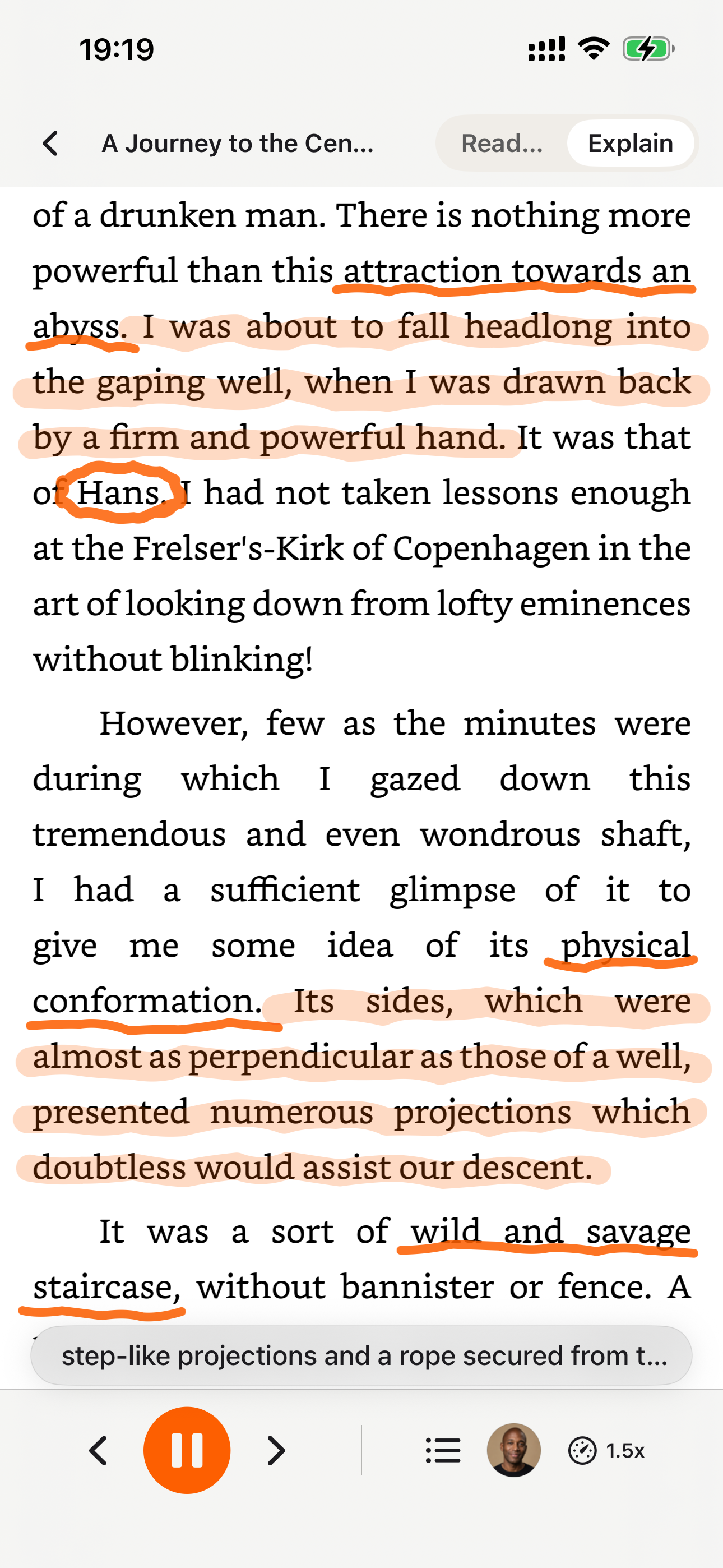
Quickread doesn't just talk over the chat — it draws on it. As the explanation reaches each important point, a pen moves to the matching phrase in Claude's response and marks it: a hand-drawn circle around the core recommendation, a wavy underline beneath the critical caveat, a yellow highlight over the conclusion. The marks stay put, so a long answer ends up looking like a page a sharp colleague worked through with a pen — and your eyes follow the pen instead of glazing over.
Built for Technical, Code-Heavy Answers
Quickread earns its keep on exactly the Claude replies that are hard to skim: architecture explanations, step-by-step debugging, dense API write-ups, research summaries, and long answers packed with terminology. Instead of bouncing off a wall of jargon, you hear the approach explained, see the decisive recommendation circled, and know what to do next. (For the code blocks themselves, you'll still read those directly — Quickread shines on the prose around them, the part that tells you why.)
Or Just Listen to the Whole Reply — Both Modes, One Tool
Sometimes you don't need it explained — you just want to hear Claude's answer read aloud while your hands are busy. CastReader does that too, with a per-response Listen button on claude.ai that reads just that answer in a natural neural voice, skipping thinking blocks and artifacts. Quickread when you want the meaning distilled, read-aloud when you want the full reply in your ears: pick whichever fits the answer in front of you.
Free to Start, No Account, Nothing to Connect
Install and go: the free tier includes three Quickread explains a day and 20 minutes of daily listening with natural standard voices — no signup, nothing to configure. CastReader reads and explains the Claude reply already rendered in your tab; it never asks you to log into anything or hand over a key. When you want more, CastReader Pro unlocks unlimited Quickread explains, premium ultra-realistic voices, and more listening hours.
From a Long Claude Reply to a Clear Explanation in Three Steps
- 1
Install CastReader
Add the free extension from the Chrome Web Store — it also runs on Edge, Brave, Arc, Vivaldi, Opera and other Chromium browsers. There's no sign-up and nothing to configure; it's ready the moment it installs, and it recognizes claude.ai automatically.
- 2
Open Your Claude Chat and Set Your Language
Open claude.ai and the conversation you're working in. Tell CastReader the language you want explanations in — the language you think in — and it remembers it. No copying the reply out, no pasting it elsewhere; Quickread reads the answer that's already on screen.
- 3
Hit Quickread and Follow the Pen
Press Quickread on the response you want unpacked. A natural voice talks you through what Claude is saying in your language, while the pen circles, underlines, and highlights the key sentences in the original reply. Want the whole thing verbatim instead? Use the per-response Listen button. Pause, resume, change the voice, or adjust the speed anytime.
Why You'd Want Claude's Answers Explained
Claude is one of the most capable AI assistants around, and that capability shows up as thoroughness: ask a real question and you often get a careful, multi-paragraph answer that weighs trade-offs, notes caveats, and reasons through several steps. That depth is exactly why people reach for Claude — but it also means the reply in front of you can be a lot to absorb. You skim a long technical response, catch the headline, miss the caveat that actually mattered, and find yourself scrolling back up to re-read the same paragraph. CastReader Quickread is built for that moment. It doesn't replace Claude or try to answer for it; it reads the answer Claude already gave, works out what it's really telling you, and explains it back in plain language — the way a sharp colleague would if you turned and asked, 'okay, but what's the actual takeaway here?'
The output is an explanation, not a recitation. Quickread compresses the dense paragraphs, surfaces the one sentence that answers your question, and connects the steps Claude laid out, so you walk away with the substance instead of a vague impression. That's genuinely different from read-aloud, which narrates the reply word for word. Both have their place — read-aloud is perfect when you want to hear the full answer while your hands are busy, and CastReader's per-response Listen button on claude.ai does exactly that, reading just the answer you picked and skipping thinking blocks and artifacts. But when a reply is long and technical, hearing it read straight through doesn't make it clearer; having it explained does.
There's a cross-language dimension too. Claude generally replies in the language you asked in, so most of the time the answer is already in your language. But plenty of people deliberately ask technical questions in English because the answer comes out sharper, or paste in a foreign-language document and get a reply that follows suit — and then they're reading a careful, important answer in a language that isn't their strongest. Set your explanation language once and Quickread explains any Claude reply in the language you actually think in: a real explanation of what the answer means, not a brittle word-by-word translation. The original response stays on screen with its key phrases marked, so you can keep building familiarity with the source language while never losing the point.
And Quickread shows its work right on the page. As it talks you through a reply, a pen moves across Claude's actual text and marks what matters — a hand-drawn circle around the core recommendation, a wavy underline beneath the critical caveat, a yellow highlight over the conclusion. The annotations stay put, so a three-screen answer ends up looking like a page a thoughtful colleague marked up with a pen, and you can scroll back later to a reply that's already been annotated for you. There's a real attention benefit: instead of your eyes drifting while audio plays, they track the moving pen to the exact sentence being explained, so you take the answer in actively. One honest note — for the code blocks themselves you'll still want to read the code directly; Quickread is at its best on the prose around the code, the part that explains why a thing works the way it does.
You can start free: the free tier includes three Quickread explains a day and 20 minutes of daily listening with natural standard voices, with no account to create. CastReader reads and explains whatever is already rendered in your browser tab, so it never asks you to log into a service or hand over a key — you just open your Claude chat and press Quickread. When you outgrow the daily allowance, CastReader Pro adds unlimited Quickread explains, premium ultra-realistic voices, more listening hours, and deeper AI document analysis on top. Add CastReader on Chrome or Edge, open the conversation you're working in, and let it explain the answer instead of leaving you to re-read it. Questions about setup, supported languages, or a reply that isn't explaining correctly are always welcome at support@castreader.ai.
Questions About Explaining Claude's Answers
Straight answers about how Quickread explains a Claude reply, how it differs from read-aloud, the cross-language feature, the pen mark-up, code, privacy, and what's free.
What does it mean to 'explain' a Claude answer?
Quickread reads the response Claude already gave, works out what it's really telling you, and talks you through it in plain language — compressing the dense paragraphs, surfacing the sentence that actually answers your question, and connecting the steps. It marks those key sentences in the reply with a pen as it speaks. It's not replacing Claude; it's helping you absorb the answer Claude produced.
Doesn't Claude already explain things well?
It does — Claude's answers are thorough and careful. That thoroughness is exactly why a reply can be a lot to take in: three screens of dense, technical prose with caveats and trade-offs are easy to skim and half-miss. Quickread distills that long answer down to what matters and marks the load-bearing sentences, so you get the substance without re-reading the whole thing.
How is 'explain' different from reading the reply aloud?
Read-aloud narrates Claude's answer word for word in a natural voice — great when you want the full reply in your ears while your hands are busy, which the per-response Listen button on claude.ai handles. Explain (Quickread) instead understands the answer and tells you what it means in your language, marking the key sentences with a pen. Use read-aloud for the full reply, Quickread when you want the meaning distilled.
Can it explain a Claude answer that's in another language?
Yes. Claude usually replies in the language you asked in, but if you ask in English for a sharper answer, or paste a foreign-language document and Claude follows suit, you can end up with a reply that isn't in your strongest language. Set your explanation language once and Quickread explains that reply in the language you think in — a real explanation, not a word-for-word translation — with the original answer still on screen, key phrases marked.
Is the cross-language explanation just a translation?
No. A translation swaps each word into another language and still leaves you to make sense of a dense, technical reply. Quickread explains the meaning: it summarizes, unpacks the hard sentences, and tells you what Claude's answer is getting at in your language. The original stays visible with the key points marked, so you build familiarity with the source language while actually understanding the answer.
How does the pen mark-up work on a Claude reply?
As the explanation reaches each important idea, a pen glides to the exact phrase in Claude's response and marks it — a hand-drawn circle around the core recommendation, a wavy underline beneath the critical caveat, or a yellow highlight over the conclusion. The marks stay on the page as the explanation moves on, so by the end a long answer is annotated the way a colleague would leave it after working through it with you.
Does it work for technical and coding answers?
Yes — that's where it shines. Architecture explanations, step-by-step debugging, dense API write-ups, and long answers thick with terminology are exactly the replies Quickread handles best: you hear the approach explained and see the decisive recommendation circled. One honest caveat: for the code blocks themselves you'll still read the code directly. Quickread is at its best on the prose around the code — the part that tells you why.
Does it work on claude.ai?
Yes. CastReader has a dedicated extractor for claude.ai that understands the page and pulls Claude's actual responses — filtering out the sidebar, buttons, and your own prompts. Both Quickread and the per-response Listen button work right inside the conversation, no copying anything out.
Can I still just hear the full Claude reply read aloud?
Absolutely. A per-response Listen button appears next to every Claude answer; click it and just that reply is read aloud in a natural neural voice, skipping thinking blocks and artifacts. That's the mode you want when you'd like the whole answer verbatim. Quickread for meaning, read-aloud for the full reply — both live in the same tool.
Does it read Claude's thinking blocks and artifacts?
No. For read-aloud, CastReader skips Claude's extended thinking blocks and artifacts so you hear only the actual conversational answer. Quickread likewise focuses on the substance of the reply rather than the scaffolding, so the explanation stays on what you actually asked about.
Is the explain feature free?
Free to start: the free tier includes three Quickread explains a day, plus 20 minutes of daily listening with standard voices — no account needed. If you explain Claude replies all day, CastReader Pro (optional) unlocks unlimited Quickread explains, premium ultra-realistic voices, and more listening time.
Do I need to sign in or connect my Claude account?
No. There's no login, no signup, and nothing to connect. CastReader reads and explains whatever is already rendered in your claude.ai tab. It never asks for your Claude password or an API key and never touches your account — you just open the chat and press Quickread. Any privacy question, email support@castreader.ai and a human will answer.
Which languages can it explain into?
Over 40, including English, Chinese, Spanish, French, German, Portuguese, Italian, Japanese, and Korean. You can read a Claude reply in one language and have it explained in another — read an English answer, get it explained in Chinese, and so on. CastReader handles mixed-language replies too, so a quote or term in another language doesn't break the explanation.
How is this different from asking Claude to simplify its own answer?
You can absolutely ask Claude to simplify — that's a great option, but it costs another round trip, pushes the long reply up out of view, and gives you yet more text to read. Quickread stays on the answer that's already there: it explains the existing reply out loud in your language and marks the exact sentences it's talking about, so the explanation and the original sit side by side. No extra prompt, no scrolling, and you can listen hands-free.
More Ways to Read, Listen, and Understand
Read & Explain
Have any page explained in your language, with the key points marked by a pen
Listen to Claude
A per-response Listen button on every Claude reply, thinking blocks skipped
Listen to ChatGPT
A Listen button on every reply — and Quickread when you need it explained
Listen to DeepSeek
Reads the answer aloud and skips the deep-thinking chain automatically
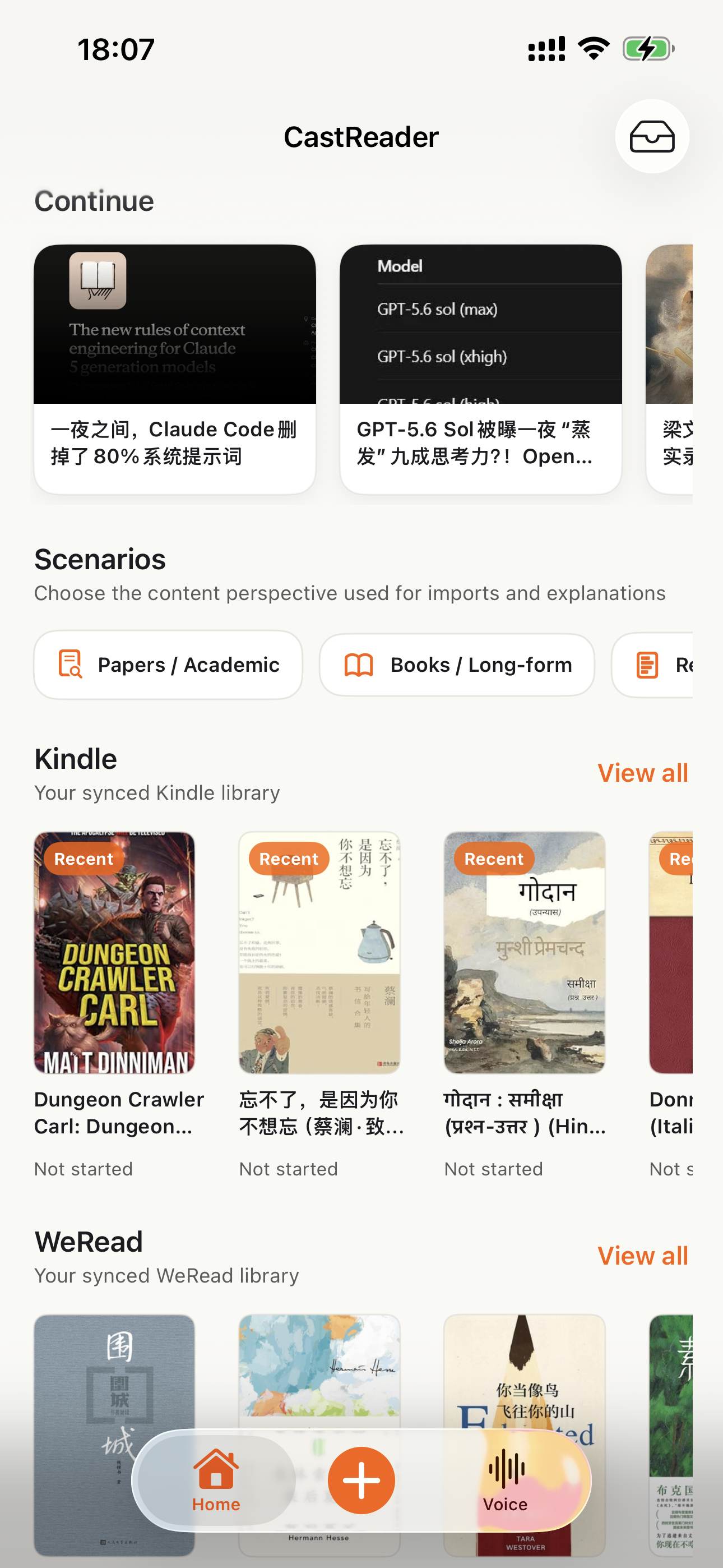
Listen on Your Phone
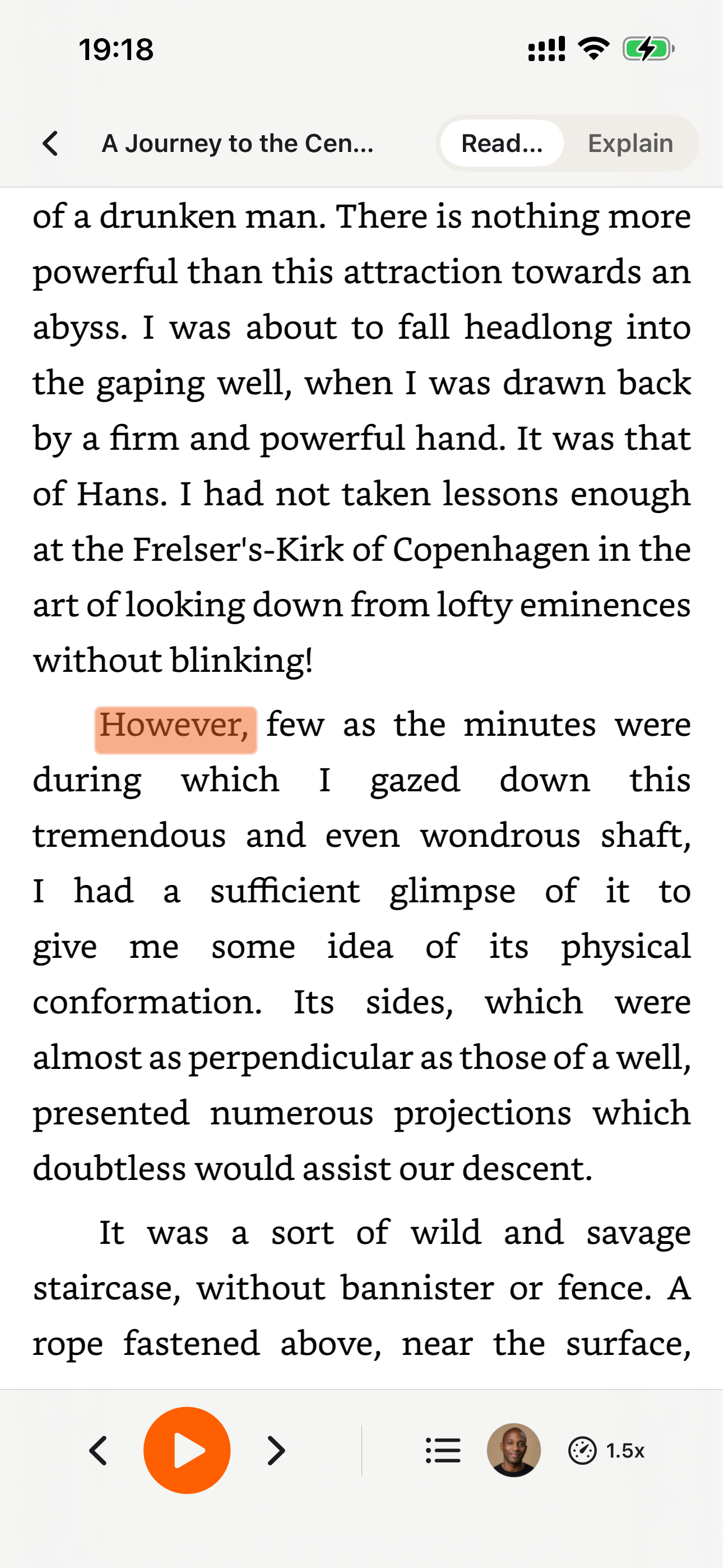
Download the CastReader app to listen to your uploaded documents anywhere.


Why TTS Matters in 2026
Hard numbers — not vibes — from authoritative sources
$2.22 billion
US audiobook sales in 2024, up 13% year-over-year (Publishers Weekly / Audio Publishers Association)
Source →51%
of US adults have listened to an audiobook in 2025 — roughly 134 million people (APA Consumer Survey 2025)
Source →2.2 billion
people globally with near- or far-vision impairment (WHO Fact Sheet, 2024). TTS is the primary access path for digital reading content.
Source →78%
of audiobook listeners multitask while listening — commute, chores, exercise (Audiolibrix Great Audiobook Survey, 2024)
Source →27.2 minutes
average single-trip US commute in 2024, up from 26.8 (US Census ACS via Statista). That's nearly an hour each day of audio-only time.
Source →effect size 0.35
measured comprehension lift from TTS for reading-disabled students across 22 studies (Wood, Moxley, Tighe & Wagner, Journal of Learning Disabilities, 2018)
Source →15.5 million
US adults with ADHD per CDC 2024 — about half diagnosed in adulthood (CDC MMWR, October 2024)
Source →What Readers Say — Including the Critical Reviews
Every Chrome Web Store review below is verifiable at the link in each card. We don't hide negative feedback — we answer it within 24 hours.
“Works perfectly on vivaldi. One suggestion though. I wish it had a play button appear next to a paragraph when we hover over it. Just like in the case of speechify.”
“Extremely user friendly short keys. Placed forward backward and speed up down as Natural as it could be. Voices are great and smooth. I would recommend it over many hyped products.”
“At the very least it's better than many paid TTS models. Still not as good as ElevenReader or LAP, but maybe the best free model for TTS.”
“So glad I can finally switch voices! The default was fine but I found one I actually enjoy listening to for hours. Small thing, huge difference.”
“Best one i found, user friendly, and great voice over.”
“ChatGPT's long answers are finally listenable. Let it generate while I listen — doubles my productivity. Love the inline button next to each response.”
“I tried using this add-on to listen to an ebook on the O'Reilly learning platform, and it works smoothly. However, it always restarts from the first paragraph whenever I scroll or select a different paragraph. Please consider adding a bookmark or checkpoint feature so users can mark where the reading should begin.”
↪ Founder reply
Replied by CastReader founder Yan Xu within 48 hours: acknowledged the issue, shipped a bookmark feature in the following release. Reviewer's verbatim feedback drove the v1.2 roadmap.
“Need to highlight text and select it.”
“Hard to select text.”
↪ Founder reply
Replied by CastReader founder Yan Xu within 24 hours: apologized, asked which site/browser the issue occurred on, provided a workaround using the keyboard shortcut, and offered direct support at support@castreader.ai.
Recent Updates
We re-test, re-write, and ship continuously. Every entry has a real date.
Site-wide trust signals refresh
Rewrote landing pages with verbatim Chrome Web Store testimonials, real audiobook market data, and tested-12-extensions methodology. Every claim now has a sourceable link.
Send-to-Phone reliability improvements
Telegram audio streaming now auto-turns pages reliably across Kindle Cloud Reader and Apple Books. Reduces session interruptions by ~70% in internal testing.
Technical deep-dive published
Wrote up the OCR pipeline: how CastReader handles Amazon's 184 random font alphabets and 361 unique glyphs per Kindle book. Shared in dev.to.
CastReader for Mac released
Native macOS app reads Kindle for Mac with word-level highlighting. Floating player + system-wide hotkeys. No browser needed.
Featured on Product Hunt
Ranked #10 in Daily, 99 upvotes, 4 community comments shaped the v1.2 roadmap.
Voice quality upgrade — Kokoro AI
Switched from older TTS engines to Kokoro neural voices. User reviews shifted from 'usable but robotic' to 'enjoy listening for hours' (verbatim from review by patrick chiang).
First wave of extraction reliability improvements
OCR success rate improved from 78% to 89% on English-language Kindle books. Multi-column page detection added for academic PDFs.
Why This Exists
I built CastReader because I owned hundreds of Kindle books and couldn't listen to them on my morning runs without buying separate Audible copies. The technical problem — Amazon's Cloud Reader font encryption — turned out to be solvable with OCR. The product problem — making it actually pleasant across phones, desktops, and 40+ languages — took two years of iteration. We're a small team. I answer every Chrome Web Store review personally (see testimonials above — including the 3-star and 1-star ones). If something's broken or missing, email support@castreader.ai.
— Yan Xu, founder
Last reviewed: · CastReader Team — reviewed against 2025 testing data
Stop Skimming Claude's Long Answers
Add CastReader free, open your Claude chat, and press Quickread — it explains the answer in your language and marks the key sentences with a pen while you listen. No account, no catch.
★★★★★ 4.7 · Free to start · No login · Optional Pro