Understand Any arXiv Paper — Explained in Your Language

You open an arXiv paper, read the abstract twice, hit the first wall of notation, and lose the thread by the related-work section. If English isn't your first language, every paragraph costs double. Most reading tools just narrate the words and leave the math as opaque as before. CastReader Quickread reads the paper, explains what it's actually proposing in the language you think in, and marks the key claims with a moving pen as it talks — so you walk away knowing what the paper does, not just that you heard it. Free to start, no sign-up.

Free to StartNo sign-upInstant40+ languages

Want to understand an English arXiv paper without grinding through every line? CastReader explains it in your own language — a spoken explanation of the problem, method, and result, not a word-for-word translation — with the key claims marked on the original. Open the paper, choose your language, and listen. Free to start, no signup.

arXivAprendizaje por Refuerzo Eficiente mediante Reuso de TrayectoriasExplaining
Spanish paperEnglish

Presentamos un método que mejora la eficiencia de muestras en el aprendizaje por refuerzo reutilizando trayectorias pasadas. Nuestro enfoque repondera los datos fuera de política con una corrección de muestreo por importancia, lo que reduce la varianza manteniendo el estimador insesgado. En tareas de control continuo, logra una reducción del cuarenta por ciento en las muestras necesarias para igualar el rendimiento de referencia.

Themethodreusespasttrajectories.

1/51.0×

Stuck on the jargon in a foreign-language paper? Quickread explains the abstract and method in your language, marking the key concepts right on the page.

Cross-language40+

Papers, reviews, technical docs — Quickread explains any of them in the language you know best, same pen, same mark-up.

English中文日本語EspañolFrançaisDeutsch+40 more

Narration Reads the Paper. Quickread Tells You What It Does.

Plain text-to-speech recites an arXiv paper and stops there — and a paper read aloud word for word is, if anything, harder to follow than reading it. Quickread does what a narrator can't: it reads the paper, figures out what it's actually proposing, explains the problem, method, and result in your language, and points at the load-bearing claims while it speaks.

Get the Method and Result, Not Just the Audio

A normal reader will narrate twelve pages of dense results and leave you no clearer on what the authors actually did. Quickread reads the paper, works out the contribution, and walks you through it in the order that makes sense: the problem they're attacking, the idea behind their approach, the result that matters, and the catch in the limitations. It compresses the related-work survey, surfaces the one equation that carries the method, and tells you whether the paper is worth a careful read before you commit an hour to it. You triage a stack of arXiv links in the time it used to take to get through one abstract.

Read an English Paper, Understood in Your Language

Almost everything on arXiv is in English, and if that isn't your first language every paragraph is friction — you translate in your head, lose the argument, and reread. Quickread explains an English paper in the language you actually think in: not a stiff machine translation of every word, but a real explanation of what the authors mean. Set your explanation language once and every paper comes back to you in it, with the original text and equations on screen and the key claims marked — so the language stops being the bottleneck and you can read at the level of your field, not your English.

Decode the Jargon, Notation, and Method

Research papers are written by specialists for specialists: undefined acronyms, notation that assumes you've read three prior papers, a method section that skips the steps everyone in the subfield already knows. Quickread unpacks it as it explains — telling you what a symbol stands for, what a term means in context, and what a dense equation is really saying in plain words — instead of leaving you to chase citations and lose your place. You stay on papers above your current level and actually follow the method, not just the abstract.

A Pen Marks the Key Claims as It Talks

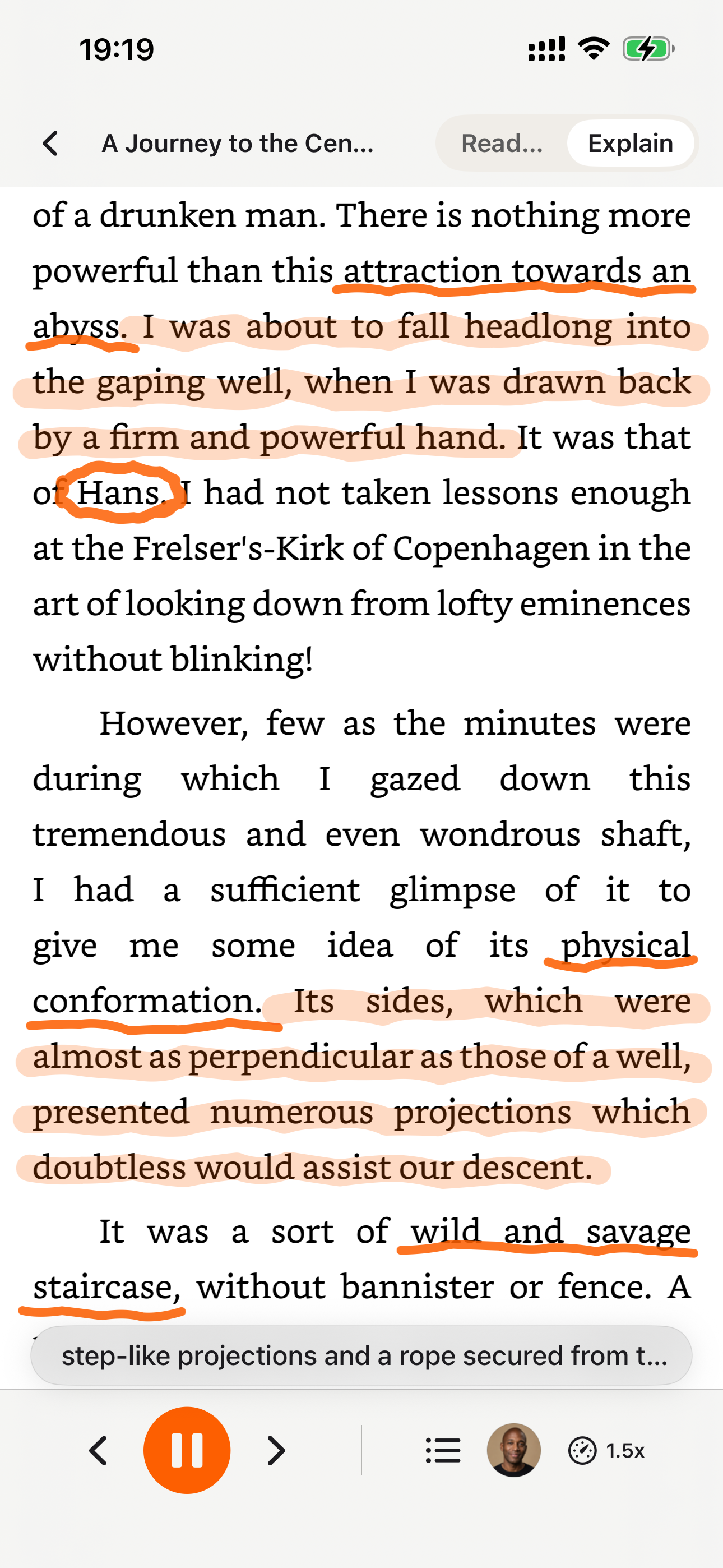
Quickread doesn't just talk over the paper — it draws on it. As the explanation reaches each important point, a pen moves to the exact line in the paper and marks it: a hand-drawn circle around the core contribution, a wavy underline beneath the key result, a yellow highlight over the assumption the whole method rests on. The marks stay put, so by the end the paper looks like one a careful researcher worked through with a pen. Your eyes follow the moving pen to the equation or claim being explained instead of skimming, and you can glance back later to a paper that's already annotated for you.

Or Just Listen to the Whole Paper, Word for Word

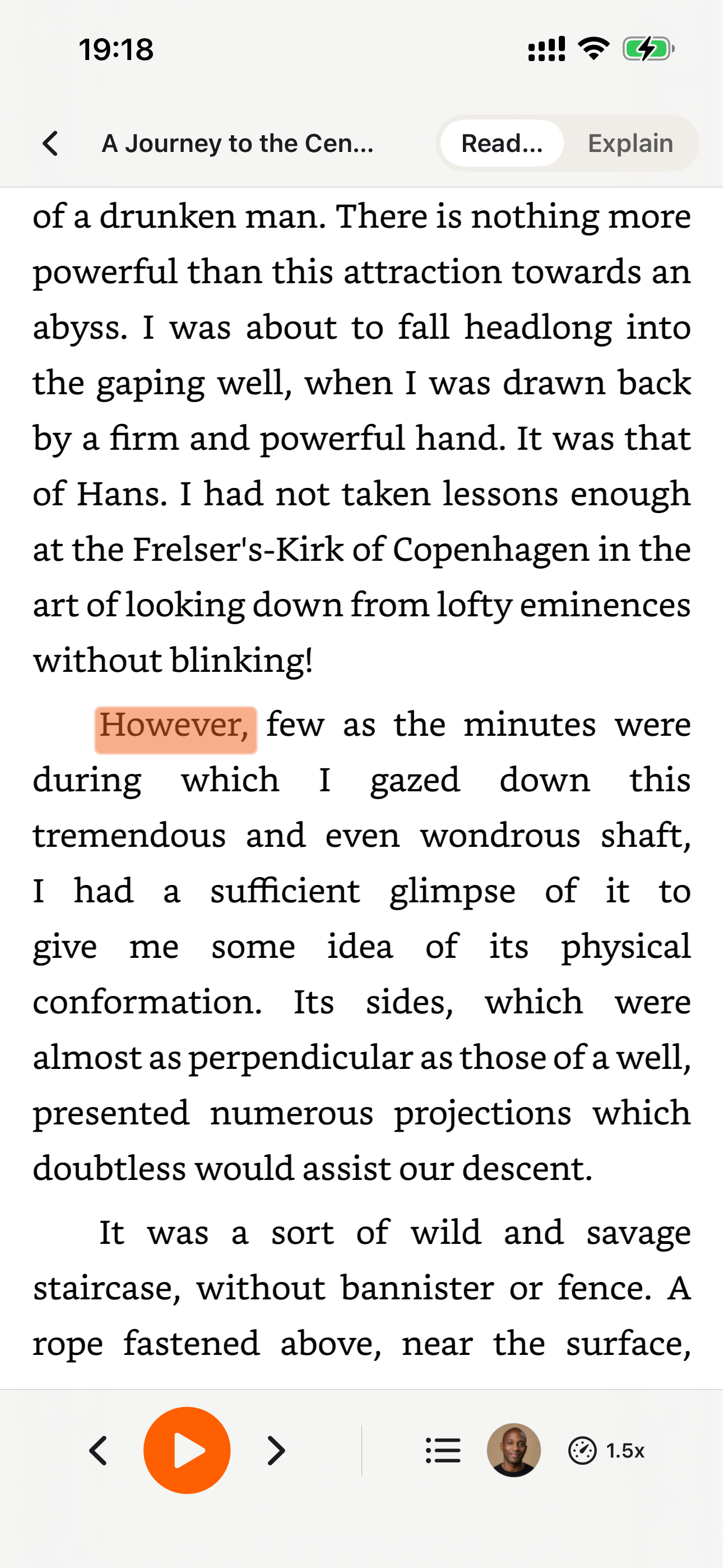
Sometimes you want the paper itself in your ears — the exact wording of the introduction or the discussion, hands-free, on a commute or while your eyes rest. CastReader does that too. Switch to straight read-aloud and a natural neural voice narrates the arXiv paper word for word, with the current sentence highlighting and the view scrolling to keep pace. Quickread to understand the method, read-aloud to absorb the prose section by section — pick whichever the paper, and the moment, calls for.

Free to Start, No Account, Nothing to Connect

Install and go: the free tier includes three Quickread explains a day and 20 minutes of daily listening with natural standard voices — no signup, nothing to configure. CastReader explains and reads what's already rendered in your browser tab, so it works the same on the arXiv abstract page or the full HTML paper, and it never asks you to log in or hand over a password. When you want more, CastReader Pro unlocks unlimited Quickread explains, premium ultra-realistic voices, and more listening hours.

From a Paper You Can't Get Past Page Two to Its Method in Three Steps

  1. 1

    Install CastReader

    Add the free extension from the Chrome Web Store — it also runs on Edge, Brave, Arc, Vivaldi, Opera and other Chromium browsers. There's no sign-up and nothing to configure; it's ready the moment it installs.

  2. 2

    Open the arXiv Paper and Set Your Language

    Open any paper on arXiv — the abstract page or the full HTML version. Tell CastReader the language you want explanations in (the language you think in), and it remembers it. No copying, no pasting, no PDF export; Quickread reads the paper that's already on screen.

  3. 3

    Hit Quickread and Follow the Pen

    Press Quickread and lean back. A natural voice walks you through the problem, method, and result in your language while the pen circles, underlines, and highlights the key claims and equations in the paper. Want the full text verbatim instead? Switch to read-aloud and it's narrated word for word. Pause, resume, change the voice, or adjust the speed anytime.

Why arXiv Papers Are So Hard to Get Through

An arXiv paper is one of the densest things you'll ever try to read. A few thousand words carry a problem statement, a survey of prior work, a method described in notation, a wall of experiments, and a discussion that assumes you followed all of it — and they're written for people who already work in the subfield. You read the abstract, feel like you almost have it, hit an undefined symbol on page three, double back, and an hour later you're not sure you could say in one sentence what the paper actually contributes. If English isn't your first language, add a translation tax to every paragraph. A text-to-speech tool that only recites the words makes this worse, not better: hearing twelve pages of equations and ablations read aloud is more confusing than reading them.

CastReader Quickread is built for that gap. Instead of just narrating a paper, it reads the whole thing, works out what the authors are actually proposing, and explains it to you in plain language — the way a senior labmate who already read it would catch you up at the whiteboard. It tells you the problem, the core idea, the result that matters, and the limitation that qualifies it; it compresses the related-work survey and points to the one equation that carries the method. For a stack of papers you've been meaning to read, that's the difference between bouncing off the abstract and getting the contribution in a few minutes — then deciding, with the gist in hand, which papers earn a careful line-by-line read.

Two things make Quickread especially useful on arXiv. The first is cross-language understanding. The overwhelming majority of research is published in English, and for a non-native reader that's a real bottleneck — you spend energy decoding the language that should go to understanding the science. Quickread explains an English paper in the language you actually think in: not a brittle word-for-word translation, but a real explanation of what the authors mean, with the original text and equations on screen and the key claims marked. Set your language once and every paper comes back to you in it. The second is the technical layer: Quickread unpacks notation, defines acronyms in context, and says in plain words what a dense equation is doing — so you follow the method, not just the abstract, and stay on papers above your current level.

Quickread also shows its work on the page. As it talks you through a paper, a pen moves across the text and marks what matters — a hand-drawn circle around the core contribution, a wavy underline beneath the key result, a yellow highlight over the assumption the whole approach depends on. The annotations accumulate and stay put, so what you're left with looks like a paper a careful researcher marked up. There's a real attention benefit: instead of your eyes drifting while audio plays, they track the moving pen to the exact equation or claim being explained. You read actively, you always know where you are in the argument, and you can scroll back later to a paper that's already annotated — useful when you're preparing a reading-group presentation, writing related work, or deciding whether to cite it.

And when you want the paper itself, Quickread gets out of the way. Switch to straight read-aloud and a natural neural voice narrates the arXiv paper exactly as written, with live sentence highlighting and auto-scroll — handy for absorbing the introduction or discussion on a commute, or resting your eyes after a long screen day. One tool covers both intents: read-aloud when you want the authors' words, Quickread when you want to understand the method, and you choose per paper. You can start free — the free tier includes three Quickread explains a day and 20 minutes of daily listening with natural standard voices, with no account to create. CastReader explains whatever is already rendered in your browser tab, so it works on the arXiv abstract or the full HTML paper without any export or upload, and it never asks for a login or password. When you outgrow the daily allowance, CastReader Pro adds unlimited Quickread explains, premium ultra-realistic voices, and more listening hours. Questions about setup, supported languages, or a paper that isn't explaining correctly are always welcome at support@castreader.com.

Questions About Explaining arXiv Papers

Straight answers about explaining dense and English-language papers, how 'explain' differs from read-aloud, the cross-language feature, notation and jargon, the pen mark-up, where it works, and the free tier.

What does Quickread do with an arXiv paper?

It reads the whole paper, works out what the authors are actually proposing, and explains it to you in plain language — the problem, the core idea, the result that matters, and the limitation that qualifies it. It compresses the related-work survey and points to the equation that carries the method. While it explains, a pen marks the key claims in the paper with a circle, underline, or highlight. You get the contribution of a twelve-page paper in a few minutes, with the source right in front of you.

I'm not a native English speaker — can it explain a paper in my language?

Yes — this is a headline feature. Set the language you want explanations in (the one you think in), and Quickread explains any English arXiv paper in that language. You hear a real explanation of what the authors mean, not a stiff word-for-word machine translation, while the original text and equations stay on screen with the key claims marked. The language stops being the bottleneck, so you can read at the level of your field instead of your English.

Is the cross-language explanation just a translation?

No. A translation swaps each word into another language and still leaves you to make sense of a dense, notation-heavy paper. Quickread explains the meaning: it summarizes the contribution, decodes the notation, unpacks the hard sentences, and tells you what the authors are getting at in your language. The original paper stays visible with the key points marked, so you build vocabulary in the source language while actually understanding the work — translation gives you words, Quickread gives you comprehension.

Can it explain the math, notation, and method?

That's a big part of what it's for. Quickread defines acronyms in context, tells you what a symbol stands for, and says in plain words what a dense equation is actually doing — instead of leaving you to chase three prior papers to decode one line. It walks through the method section in the order that makes sense, so you follow how the approach works rather than just hearing the abstract. It won't replace a careful derivation, but it gets you to the point where the careful read is doable.

What's the difference between read-aloud and explain on a paper?

Read-aloud narrates the paper exactly as written — same words, natural voice — so you can listen to the introduction or discussion hands-free. Explain (Quickread) goes further: it reads the paper, works out the method and result, and talks you through it in your own language, marking the key claims with a pen. Use read-aloud when you want the authors' exact prose; use Quickread when a paper is dense, notation-heavy, or in English you'd rather not grind through. CastReader does both.

Does it work on the abstract page and the full paper?

Yes. CastReader reads and explains whatever is already rendered in your browser tab. That includes the arXiv abstract page for a quick triage and the full HTML version of a paper for the complete method and results. If the text is showing on screen, Quickread can explain it — no PDF export, no copying, no uploading.

How does the pen mark-up work?

As the explanation reaches each important point, a pen glides to the exact line in the paper and marks it — a hand-drawn circle around the core contribution, a wavy underline beneath the key result, a yellow highlight over the assumption the method rests on. The marks stay on the page as the explanation moves on, so by the end the paper is annotated the way a careful researcher would leave it — handy when you're prepping a reading group or writing related work.

Why is a moving pen better than just playing audio?

Because it keeps your attention anchored to the math. When audio plays over a dense paper, eyes drift and you zone out at exactly the moment the notation gets hard. The moving pen pulls your gaze to the precise equation or claim being explained, so you follow along actively and always know where you are in the argument. And because the marks stay put, you can glance back later to a paper that's already been highlighted and annotated for you.

Can I have a whole paper read aloud word for word instead?

Absolutely. Switch to read-aloud and a natural neural voice narrates the arXiv paper exactly as written, with the current sentence highlighting and the view scrolling to keep pace. That's the mode for absorbing the introduction or discussion on a commute, or resting your eyes after a long day of reading. Quickread to understand the method, read-aloud for the authors' words — both live in the same tool.

Does it work on other papers and academic sources too?

Yes. While this page is about arXiv, Quickread and read-aloud work on academic content across the web: bioRxiv and other preprint servers, journal HTML pages, conference proceedings, lab blogs, and more. If the text is rendered in your browser tab, CastReader can read it aloud or explain it — no exporting, copying, or uploading.

Is explaining arXiv papers free?

Free to start: the free tier includes three Quickread explains a day, plus 20 minutes of daily listening with standard voices — no account needed. If you read and explain papers all day, CastReader Pro (optional) unlocks unlimited Quickread explains, premium ultra-realistic voices, and more listening time.

Which languages can it explain into, and from?

Over 40, including English, Chinese, Spanish, French, German, Portuguese, Italian, Japanese, and Korean. Most arXiv papers are in English, and you can have one explained in any of these — read an English paper, get it explained in Chinese; read an English paper, get it explained in Spanish. CastReader handles mixed-language and notation-heavy passages too, so equations and symbols don't break the explanation.

The explanation or pen mark-up isn't showing on a paper — what should I check?

First reload the arXiv tab so the extension can attach to a freshly rendered page, and confirm CastReader is enabled in your browser's extensions menu. Make sure you've chosen an explanation language and that the tab isn't muted. The full HTML version of a paper usually explains more cleanly than a raw PDF view. If Quickread still doesn't trigger, toggle the extension off and on or reinstall from the store. Persistent issues are usually fixed fast once we know your browser and a sample paper — email support@castreader.com.

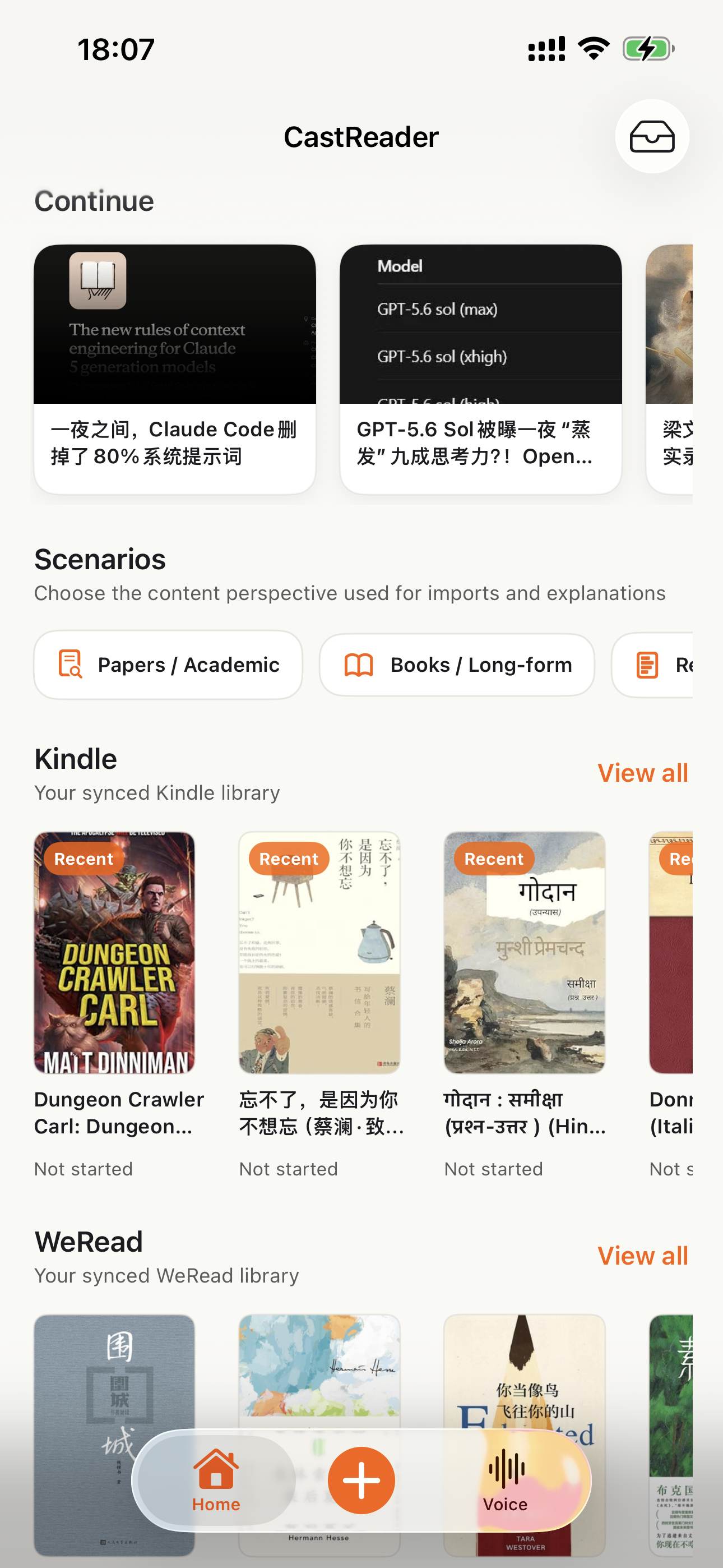
Listen on Your Phone

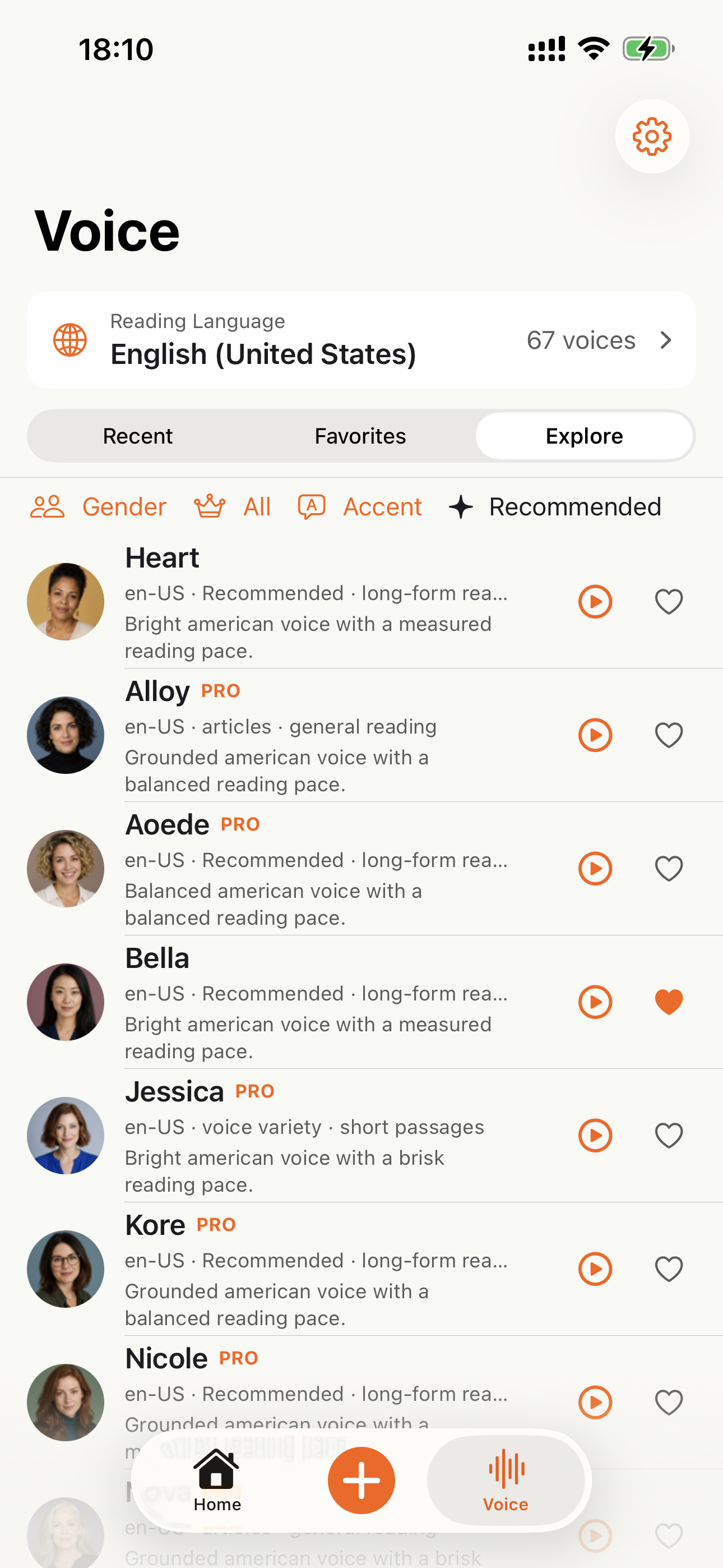
Download the CastReader app to listen to your uploaded documents anywhere.

Explore books
Book details
Reading experience

Why TTS Matters in 2026

Hard numbers — not vibes — from authoritative sources

$2.22 billion

US audiobook sales in 2024, up 13% year-over-year (Publishers Weekly / Audio Publishers Association)

Source →

51%

of US adults have listened to an audiobook in 2025 — roughly 134 million people (APA Consumer Survey 2025)

Source →

2.2 billion

people globally with near- or far-vision impairment (WHO Fact Sheet, 2024). TTS is the primary access path for digital reading content.

Source →

78%

of audiobook listeners multitask while listening — commute, chores, exercise (Audiolibrix Great Audiobook Survey, 2024)

Source →

27.2 minutes

average single-trip US commute in 2024, up from 26.8 (US Census ACS via Statista). That's nearly an hour each day of audio-only time.

Source →

effect size 0.35

measured comprehension lift from TTS for reading-disabled students across 22 studies (Wood, Moxley, Tighe & Wagner, Journal of Learning Disabilities, 2018)

Source →

15.5 million

US adults with ADHD per CDC 2024 — about half diagnosed in adulthood (CDC MMWR, October 2024)

Source →

What Readers Say — Including the Critical Reviews

Every Chrome Web Store review below is verifiable at the link in each card. We don't hide negative feedback — we answer it within 24 hours.

★★★★★
This is 1 of the best TTS and its smooth. If this is truly free i'll keep this 100%. Every other TTS says its free but has a secret. They interrupt or they just say better ai voices pay. But i like this voice. I've tried loads and this is 1 of the best ones that actually says free.
Jordan · Chrome Web Store
★★★★★
Works perfectly on vivaldi. One suggestion though. I wish it had a play button appear next to a paragraph when we hover over it. Just like in the case of speechify.
Loic COBBINA · Chrome Web Store
★★★★★
Extremely user friendly short keys. Placed forward backward and speed up down as Natural as it could be. Voices are great and smooth. I would recommend it over many hyped products.
grann tosif · Chrome Web Store
★★★★★
At the very least it's better than many paid TTS models. Still not as good as ElevenReader or LAP, but maybe the best free model for TTS.
eclpse_ · Chrome Web Store
★★★★★
So glad I can finally switch voices! The default was fine but I found one I actually enjoy listening to for hours. Small thing, huge difference.
patrick chiang · Chrome Web Store
★★★★★
Best one i found, user friendly, and great voice over.
Mohab A · Chrome Web Store
★★★★★
ChatGPT's long answers are finally listenable. Let it generate while I listen — doubles my productivity. Love the inline button next to each response.
young D · Chrome Web Store
★★★★★
I tried using this add-on to listen to an ebook on the O'Reilly learning platform, and it works smoothly. However, it always restarts from the first paragraph whenever I scroll or select a different paragraph. Please consider adding a bookmark or checkpoint feature so users can mark where the reading should begin.

↪ Founder reply

Replied by CastReader founder Yan Xu within 48 hours: acknowledged the issue, shipped a bookmark feature in the following release. Reviewer's verbatim feedback drove the v1.2 roadmap.

Hedi · Chrome Web Store
★★★★
Need to highlight text and select it.
Vivian Le · Chrome Web Store
★★★★
Hard to select text.

↪ Founder reply

Replied by CastReader founder Yan Xu within 24 hours: apologized, asked which site/browser the issue occurred on, provided a workaround using the keyboard shortcut, and offered direct support at support@castreader.ai.

David Smolinski · Chrome Web Store

Read all 28 reviews on Chrome Web Store

Recent Updates

We re-test, re-write, and ship continuously. Every entry has a real date.

  1. Site-wide trust signals refresh

    Rewrote landing pages with verbatim Chrome Web Store testimonials, real audiobook market data, and tested-12-extensions methodology. Every claim now has a sourceable link.

  2. Send-to-Phone reliability improvements

    Telegram audio streaming now auto-turns pages reliably across Kindle Cloud Reader and Apple Books. Reduces session interruptions by ~70% in internal testing.

  3. Technical deep-dive published

    Wrote up the OCR pipeline: how CastReader handles Amazon's 184 random font alphabets and 361 unique glyphs per Kindle book. Shared in dev.to.

  4. CastReader for Mac released

    Native macOS app reads Kindle for Mac with word-level highlighting. Floating player + system-wide hotkeys. No browser needed.

  5. Featured on Product Hunt

    Ranked #10 in Daily, 99 upvotes, 4 community comments shaped the v1.2 roadmap.

  6. Voice quality upgrade — Kokoro AI

    Switched from older TTS engines to Kokoro neural voices. User reviews shifted from 'usable but robotic' to 'enjoy listening for hours' (verbatim from review by patrick chiang).

  7. First wave of extraction reliability improvements

    OCR success rate improved from 78% to 89% on English-language Kindle books. Multi-column page detection added for academic PDFs.

Why This Exists

I built CastReader because I owned hundreds of Kindle books and couldn't listen to them on my morning runs without buying separate Audible copies. The technical problem — Amazon's Cloud Reader font encryption — turned out to be solvable with OCR. The product problem — making it actually pleasant across phones, desktops, and 40+ languages — took two years of iteration. We're a small team. I answer every Chrome Web Store review personally (see testimonials above — including the 3-star and 1-star ones). If something's broken or missing, email support@castreader.ai.

— Yan Xu, founder

Last reviewed: · CastReader Team — reviewed against 2025 testing data

Stop Bouncing Off Papers at the First Wall of Notation

Add CastReader free, open that arXiv paper, and press Quickread — it explains the problem, method, and result in your language and marks the key claims with a pen while you listen. No account, no catch.

Any website· Kindle / WeChat / Notion· PDF / EPUB / DOCX· 40+ languages

★★★★★ 4.7 · Free to start · No login · Optional Pro

Explain an arXiv Paper in Your Language — Understand Any Research Paper | CastReader