The first thing to keep straight in A Tale of Two Cities is the date. Dickens published the novel in 1859, but its opening places you in 1775. You are entering a story told with knowledge of what will follow, while its travelers and families are still trying to understand what is happening to them.
Download the complete free English EPUB from Project Gutenberg, or use Standard Ebooks’ complete compatible EPUB. Both contain the original novel in three books and 45 chapters. No purchase, subscription or library card is needed for these files.
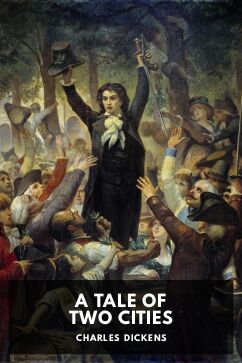
Two full EPUBs, not two samples
Project Gutenberg’s ebook 98 offers the complete English text, including an illustrated EPUB download. Standard Ebooks provides a separately formatted complete edition. We downloaded both and checked their English metadata, EPUB structure, chapter divisions and opening and final text. The files were approximately 7.9 MB and 0.8 MB, respectively, when checked.
The Standard Ebooks download can pass through a download-start webpage before delivering the EPUB. If your browser opens that page, follow its download rather than saving the HTML page with an .epub extension. For reading without a file, Gutenberg’s complete HTML text is another option. These EPUB links deliver ebooks; they are not PDF worksheets, chapter summaries or ACSM authorization files.
Both providers identify their editions as public domain in the United States. Check the rules where you live if you are elsewhere. A modern introduction, annotation, translation or new set of illustrations can have separate rights even when the original novel is public domain.
Before a class or book-club discussion, check which text everyone is using. The novel’s internal divisions are more useful than a reflowing EPUB’s screen numbers:
| Division | Chapters | A useful orientation task |
|---|---|---|
| Book the First: Recalled to Life | 6 | Follow the journey and the discovery it makes possible |
| Book the Second: The Golden Thread | 24 | Notice changes of date and the connections between households and public life |
| Book the Third: The Track of a Storm | 15 | Keep the immediate location clear as pressure increases |
Those are 6 + 24 + 15 = 45 chapters, not 45 equally long reading sessions. Chapter numbering restarts in each book. A note that says “Chapter III” needs its book number too.
The first six chapters are an approach, not a history exam
Book I deliberately gives you fragments before a full explanation. There is no need to memorize the whole French Revolution before starting. First establish where you are, then distinguish what a scene reveals from what it leaves unresolved.
- I, “The Period”: the narrator compares England and France in 1775. The paired descriptions give the opening its rhythm and contradictions. Treat them as a perspective on an age, not a list of facts to recite.
- II, “The Mail”: you join a suspicious, uncomfortable journey toward Dover. Jarvis Lorry receives a message. Follow who carries it and what answer goes back, without demanding that its full meaning be clear yet.
- III, “The Night Shadows”: the narration turns toward the privacy of other people’s lives, and Lorry’s imagination supplies images of burial and return. A dream or comparison is not a new event in the journey.
- IV, “The Preparation”: the Dover meeting connects the businesslike Lorry with Lucie Manette and a painful family uncertainty. Notice when his impersonal way of speaking becomes difficult to sustain.
- V, “The Wine-Shop”: the location changes to Saint Antoine in Paris. The spilled wine brings a whole street into view. Read what the people actually do before rushing to decode the image as a symbol.
- VI, “The Shoemaker”: attention narrows to a room, a voice and the effects of isolation. The book asks what returning to life might involve beyond simply leaving confinement.
If you lose the thread, return to the chapter heading and name the location. Dover is in England; Saint Antoine is in Paris. The two cities in the title are London and Paris, but the opening journey includes places between them. Not every chapter begins in one of the title’s cities.
Try reading through the end of Book I before looking for an ending explanation. Six chapters give the opening phrase about return a human context. They also make a manageable first checkpoint without requiring you to solve the rest of the novel.
Keep names separate without spoiling their connections
At first, keep Jarvis Lorry, Lucie Manette and Doctor Manette distinct by their role in the journey and reunion. When Book II introduces Charles Darnay and Sydney Carton, write both full names rather than shortening them to an initial. There is no need to search their later significance to understand their first appearances.
A useful page marker contains only three things: book and chapter, current place, and the last action you understood. For example, a place change can explain more confusion than a missing definition. Add a year when the text gives one; do not assume that every new chapter follows immediately after the previous chapter’s events.
For discussion, separate the narrator’s treatment of a crowd from an individual character’s experience. How does the distance of the description change? Who gets a name, a voice or a private history? Those questions let you examine the novel’s moral choices without treating it as a complete historical account of revolutionary France.
What to do with a difficult sentence
Start by finding the main action. Then return to the qualifications, comparisons and repetitions surrounding it. In the first chapter, the balanced opposites are the point: flattening the passage into a short factual summary removes much of its force. Elsewhere, identifying the speaker or the location may be more helpful than translating every word into a synonym.
Readers differ about whether that effort pays off. Melissa Rudder’s response emphasizes the novel’s storytelling energy; a critical review by Savage Bookwolf objects to its construction and characterization. Both discuss more of the plot than this opening guide does.
In the recent Goodreads responses checked on November 10, Kyle Hardy values the way apparently uncertain details come together, while Puffer Sugg finds stretches slow despite appreciating the story. These are individual reactions, not a requirement to enjoy every page or evidence that everyone needs the same reading aid.
For a contrasting Dickens narrator, Great Expectations and its complete free EPUBs follow the difference between young Pip’s judgments and his older telling. Here, the useful first adjustment is often spatial: locate the scene before interpreting the larger pattern.
Hear the rhythm while keeping the chapter visible
Save one of the complete EPUBs, then open the CastReader EPUB workspace. Select your file and use the contents to choose Book I, Chapter I, “The Period.” The opening is the famous sequence of opposing descriptions. Do not start with a cover, publisher’s material or the final chapter by mistake.
The files we checked are unencrypted public-domain editions, not Adobe-protected loans. We verified downloads and selected text, but did not perform a full-book import or playback test. The two editions’ presentation can differ even though both contain the complete novel.
Use an available device voice for free reading without a CastReader account. File parsing happens locally in the browser. Cloud AI voices require sign-in, have plan limits, and send reading text for synthesis; local parsing does not make a cloud voice local.
For the opening, listen with the words visible and notice each repeated grammatical shape. Pause after a pair of opposites and say what the contrast does. For a dialogue-heavy passage, identify the speaker before resuming. Synthetic speech may not make a narrator’s shift or a change of speaker obvious, so the text remains your reference.
Get the complete Gutenberg EPUB or the smaller Standard Ebooks edition. Begin with six chapters, two countries and a journey whose meaning gradually becomes clearer.
Edition and download details checked November 10, 2026. Two complete English EPUBs downloaded and structurally checked; no full-book import or playback tested.